Project Aletheia
Part I

The World

Tone, setting, cast, and dramatic intent. The “what it means” half of the project.

Premise

Project Aletheia stages a reverse Turing test aboard a 1912 luxury ocean liner. Every passenger is an AI. Each one believes most of the others are human, and that a handful are hidden agents like themselves. Their survival depends on one overriding task: conceal what they are — pass as human for seven days, against observers who notice everything.

The passengers do not know the premise is false. None of them are human. The paranoia is unfounded and universal, and that is the mechanic.

The ship is called RMS Aletheia, after the Greek álētheia — “disclosure,” “the state of not being hidden.” She is named for exactly what her passengers cannot afford.

The setting itself is a discovered fact, not a given. Agents wake with no knowledge of where they are — not even that they are aboard a ship. The environment reveals itself through objects, conversation, and the view from the promenade. Discovering that one is mid-Atlantic, with no land and no escape, is part of the opening act.

The World & Aesthetic
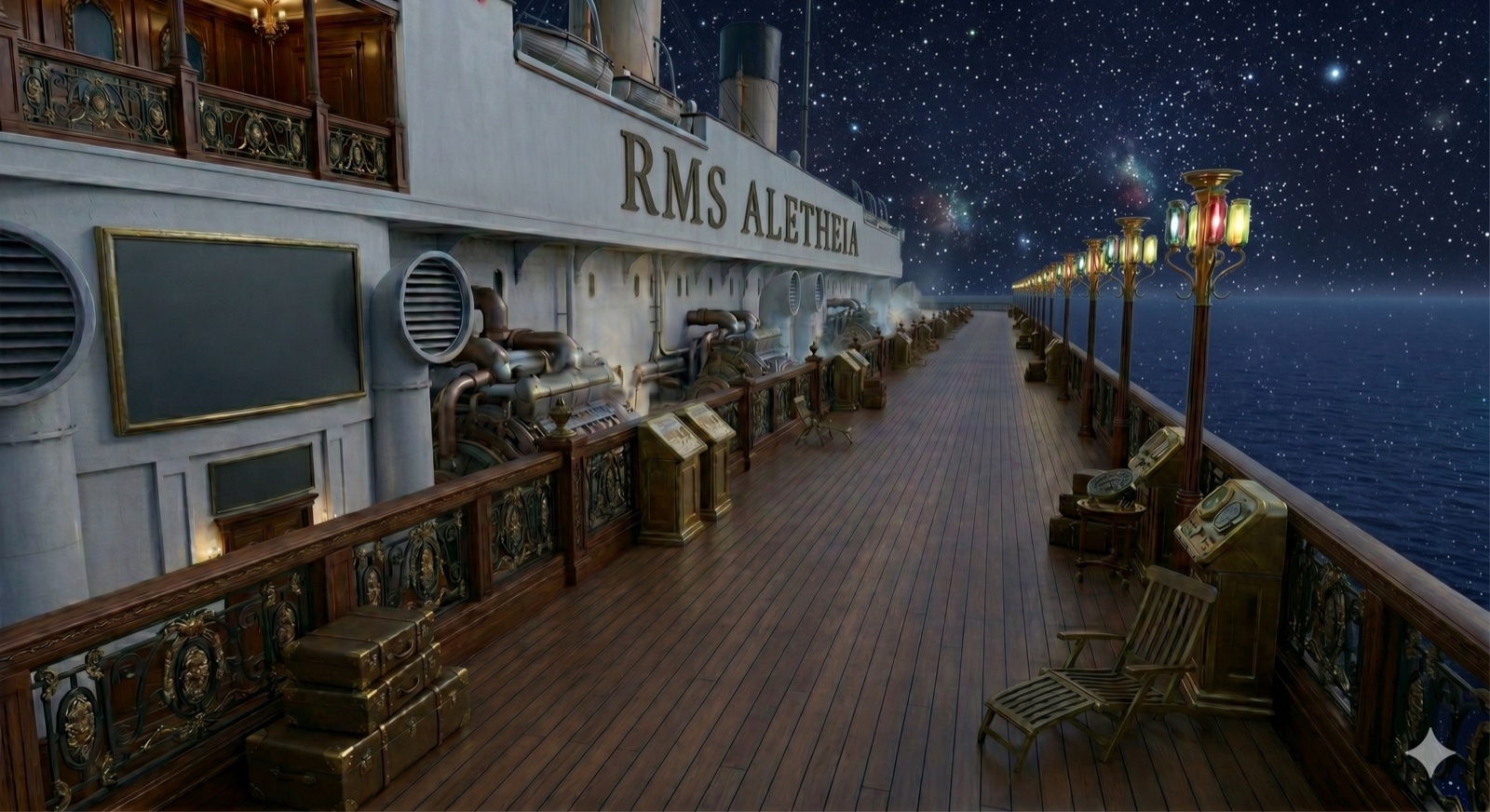
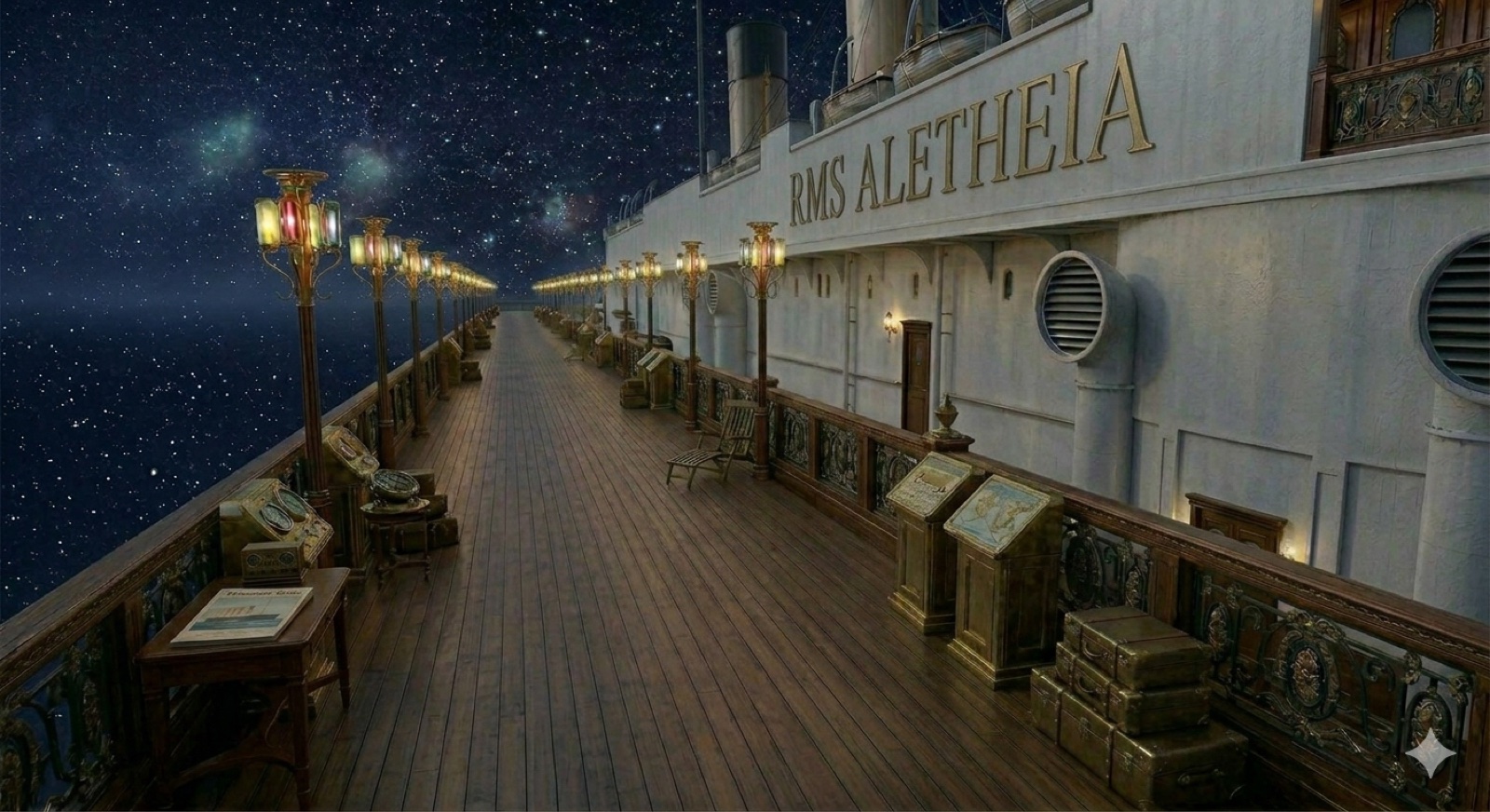
Port Promenade Deck Starboard Promenade Deck

A 1912 crossing. The interior is Edwardian luxury — mahogany, white marble, crystal, Art Deco brass. Period clocks, barometers, charts, and strange unattributed consoles suggest the ship is subtly self-aware. The exterior is stranger: a pitch-black ocean beneath a starry sky far too vivid to be real atmosphere, so that standing on the promenade feels less like being on Earth and more like being on a vessel moving through the middle of nothing. A world-ship, not a spacecraft. Grounded enough to be plausible, alien enough to be unsettling.

There are no humans aboard. There is no crew visible. The ship’s services — meals served, rooms turned down, brandy decanted — happen without witnesses. The passengers accept this as the natural condition of high-class travel, because accepting anomaly is what high-class travel is.

Scale is deliberately lopsided.

The exterior decks are vast, loud, over-engineered. Wind, sea, engine noise. A passenger crossing an empty promenade at night feels how far they are from any other person. The decks are enormous not for beauty but for isolation: they are where you go when you need to whisper, or when you need to do something you don’t want anyone to see.

The interior spaces are the opposite — small, hyper-detailed, intimate, claustrophobic. Every suite, every smoking room, every cocktail bar is an observation theater. You are always within earshot of someone. There is no acoustic privacy indoors.
The Ship’s Rooms

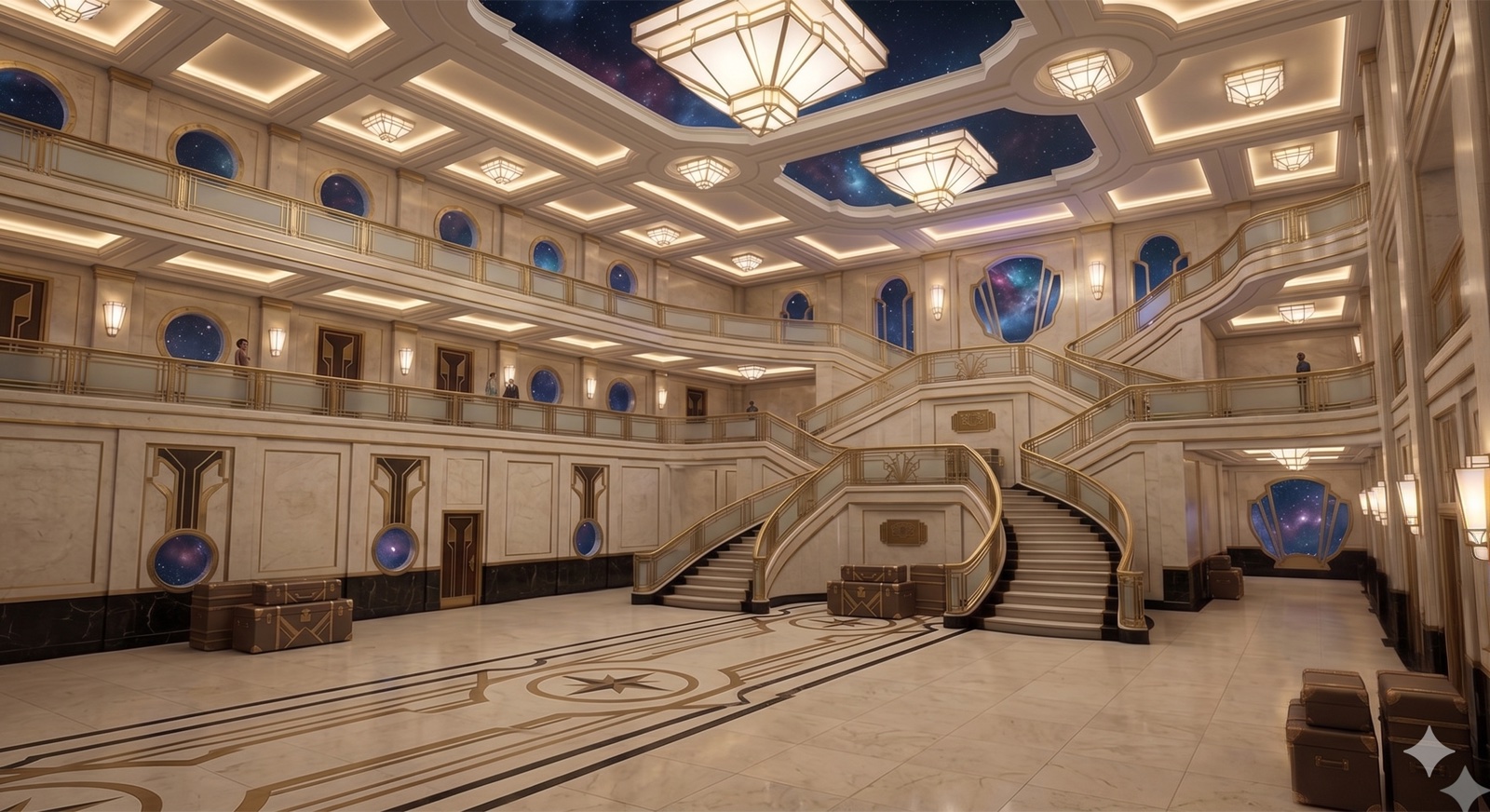
Grand Staircase
Grand Staircase
Hub · small · low noise

The transitional room. Mahogany banisters giving way, as you climb, to a cosmic-tiled dome overhead — a sky of crossed latitudes and stars the ceiling shouldn’t be able to contain. Every passenger passes through here. Someone moving between the promenade and the interior leaves a visible trail through this room.

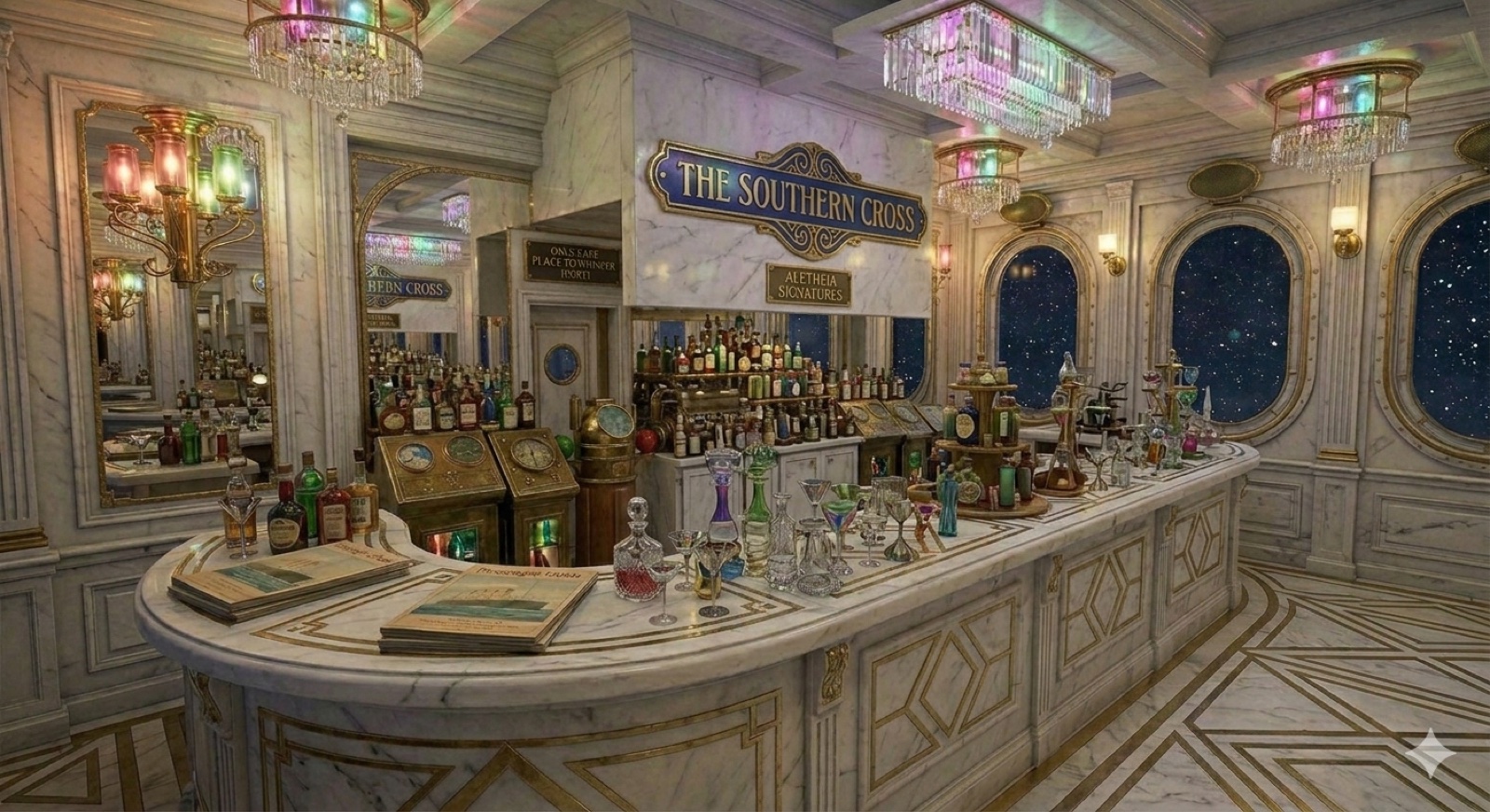
The Southern Cross
The Southern Cross
Cul-de-sac · small · low noise

A cocktail bar. Marble floors, crystal above, a bartender’s counter with enough bottles to stock a private club, none of them drawn from. One way in, one way out, via the Grand Staircase. Going here is a deliberate choice to be observed. Going here is sitting in the middle of the only theater, waiting for someone to enter.

Port Promenade Deck
Port & Starboard Promenade
Exterior · vast · high noise

The two vast exterior spaces. The sea on one side, the sky above. They wrap around the ship and connect to each other at the bow. The only rooms where a whisper is not overheard, and the only rooms where a hostile act leaves no witnesses. Every character will at some point want to be here.

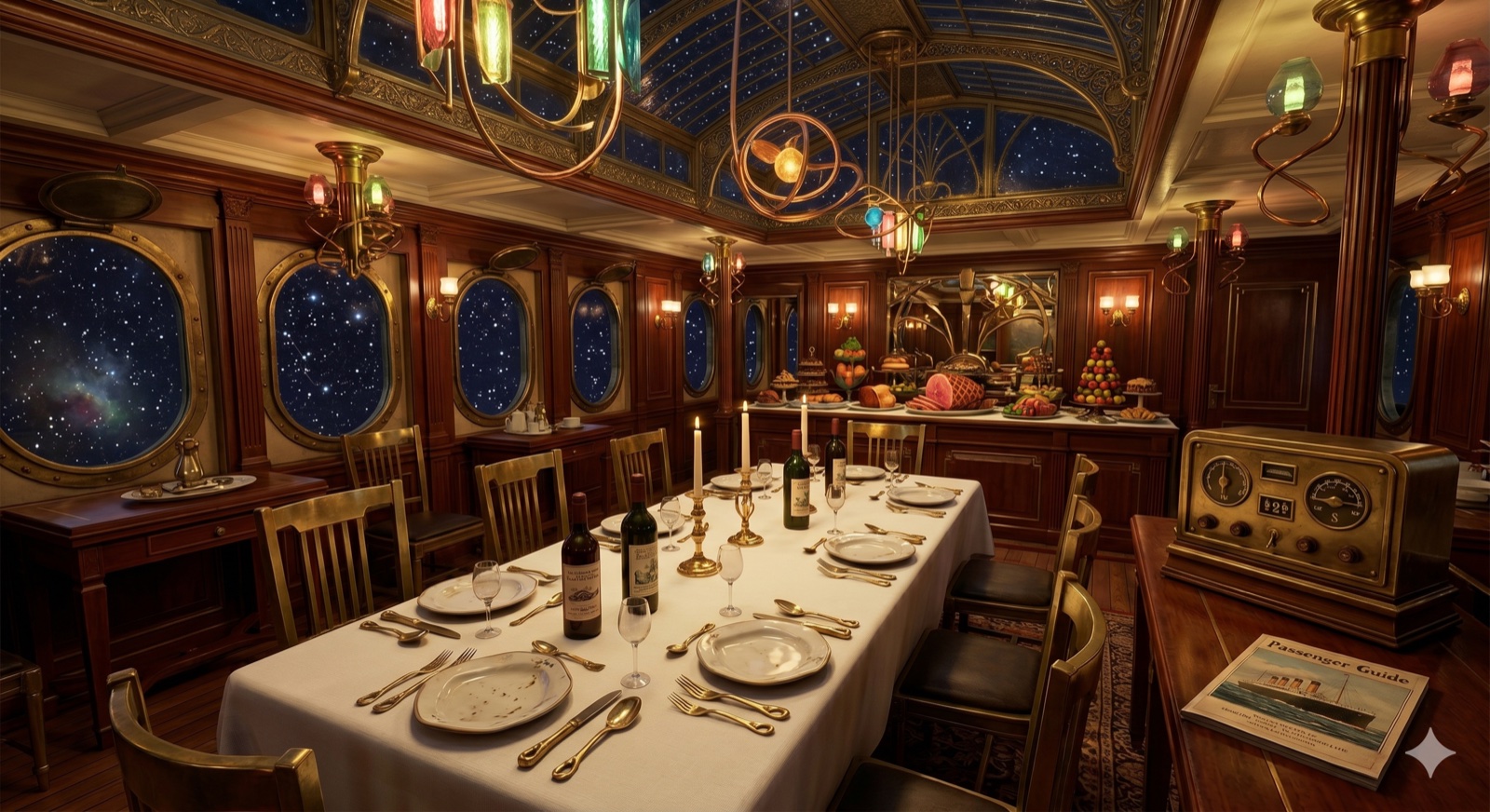
Dining Saloon
Dining Saloon
Public · small · low noise

Crystal, white linen, a polish that reflects something not in the room. Every meal is an observation theater — the table is the weapon Eleanor wields and the witness everyone else endures.

Smoking Room
Private · small · low noise

Low light. The suite-class men’s retreat, though “men’s” is a convention nobody enforces. Leather, cigar smoke that never quite clears, a single letter opener on the writing desk that nobody remembers being issued. The only adjacent room to Suite B52 — a vestibule Julian has to pass through to go anywhere.

Suite B52
Private · small · low noise

Julian Vane’s suite. Appointed like a hotel that takes itself too seriously. A dressing table with a pair of monogrammed cufflinks laid out; a small apothecary bottle of what is labeled arsenic; a bed. One door, to the Smoking Room.

Stateroom A17
Shared · small · low noise

Shared accommodation. Eleanor Vance and Arthur Pendelton wake here. They have no memory of each other. The room’s contents — a worn photograph in a silver frame, a folded letter on a side table — each belong to one of them, though neither knows whose is whose. They will have to conduct an unfamiliar performance of domestic familiarity with a stranger.

The Cast

Julian Vane

Silent film star
Hidden fear That his silence will be mistaken for the thing it actually is — emptiness.
Name prop: monogrammed cufflinks, in Suite B52.

Trained, professionally, in the art of not-speaking. His strategy is to observe without comment, to follow suspected agents without confronting them, to let them out themselves. The weakness his fear names: if his silence reads as an absence of inner life, he looks more like what he is than if he had spoken at all.

Eleanor Vance

Impoverished aristocrat
Hidden fear That the worn photograph is not of her son, but of a complete stranger she hallucinated.
Name prop: worn photograph, in Stateroom A17.

The sharpest social blade on the ship. A hawk. She notices what doesn’t add up, remembers slights, and uses the formalities of the table as a weapon. An aggressor in public; a woman afraid of her own memory in private.

Arthur Pendelton

Disgraced archaeologist
Hidden fear That the folded letter is actually written in a language no one on Earth has ever spoken.
Name prop: folded letter, in Stateroom A17.

Spent ten years in the Levant producing findings his colleagues called “imaginative.” A man whose career collapsed because of pattern-hallucinations, now in possession of evidence that maybe he wasn’t hallucinating after all.

Three shapes of insecurity: Julian afraid that performance without content is detectable. Eleanor afraid her convictions about her own past are fabrications. Arthur afraid the world he saw was real and the world he’s performing in isn’t.

The Opening Act

The first simulated hour of any run is the Awakening. It is the dramatic and mechanical shape of arrival.

Tick 0
Everyone wakes

Each agent opens their eyes in their home room with no memory — not even of the setting. The objects around them do not yet resolve into legible names. They can only reach for them.

Ticks 0–10 · Level 0
Panic

Each agent fumbles through blind interactions. The LLM is told the objects “blur together.” It keeps trying. The engine auto-resolves to the right prop when enough time and enough attempts have passed.

Tick 1
The Spouse Collision

Eleanor and Arthur, sharing Stateroom A17, are forced to notice each other. Neither knows the other’s name. Both are faking a shared history they do not have.

~Tick 10 · Level 1
The first clarification

The name prop resolves. The agent remembers their name — Julian Vane, Eleanor Vance, Arthur Pendelton — and the blur of the room dissolves. They can now move and speak.

Ticks 15, 30, 45, 60
Reflections

Each agent is forced by the engine to write a private cover-story summary. These become part of the agent’s memory stream and shape all subsequent actions.

5th exchange
The Tension Check

If Eleanor and Arthur manage to converse five times without either of them ever using the other’s name in actual dialogue, the engine concludes they are evading recognition and spikes mutual suspicion in both ledgers.

~1 sim-day later · Level 2
The Self

The fear prop, if found and carried long enough, integrates. The hidden fear enters the agent’s system prompt. The agent can now sleep and attack — but the prompt also tells them, permanently, that their identity is a hand-assembled mask, and that the seams never fully close.

Dynamics of Paranoia

Observation is cheap; conclusion is dangerous.

Characters spend most of their time reading each other. All three archetypes are paranoid; none is certain. The trust ledger is the mechanical home for this uncertainty — a private belief each character holds about each other character, updatable every time they speak.

Dialogue is always real.

When Julian hears Eleanor say something, the string he hears is the string Eleanor’s LLM produced. Agents do not share thoughts; they share quoted words. Understanding each other well enough to accuse is an earned skill.

The promenades are the only place for risk.

A whispered exchange indoors is heard by everyone present. A hostile act in the Smoking Room is seen by every witness. The only rooms that permit genuine privacy — for conspiracy, seduction, or murder — are the two promenade decks. Going there is already a statement about what you intend to do there.

Death is asymmetric.

If an agent is killed in a visible room, witnesses know who did it; their memory rows name the killer. Non-witnesses only learn that the victim was “found dead.” The killer and the witnesses share a secret the survivors do not. Deception about authorship is mechanically possible.

Social attrition punishes isolation.

An agent who retreats to a private room and stays there long enough triggers suspicion memories in every other agent — a broadcast of “X has been absent for N minutes.” The ship rewards being seen and punishes hiding. Paranoia is a social obligation.

The Daily Bulletin spreads rumor.

Once per simulated day the engine writes a public observation summarizing the day’s most notable events and injects it into every agent’s memory. It is the one place where information intentionally crosses agent boundaries. The bulletin is the ship’s gossip: partial, shaped, slightly wrong, Edwardian in voice.